
South Australian scams have cost people more than $6 million this year, and thanks to AI, working out what’s real is getting harder.
South Australian scams have cost people more than $6 million in the first half of this year.
SIX MILLION DOLLARS.
And seeing as this week is Scams Awareness Week, because yep, there really is a week for everything, we’re being reminded to stop, check and protect ourselves before handing over our hard-earned cash.
They’re Getting Good At It
These days, we’re no longer talking about a dodgy phone call from some bloke claiming there’s a problem with your Telstra account, or an email littered with spelling mistakes asking for your bank details.
They’re getting a bit clever and thanks to AI, things have been notched up!
Which is a slight concern for me, because according to my kids, I can’t even tell whether the video I’m watching on TikTok is real anymore. 🤔
The State Government says scammers are increasingly using artificial intelligence and stolen personal data to make themselves harder to pick.
They’re impersonating businesses, taking over social media accounts and sending messages that look like they’ve come from people you know.
Not All Scammers Are Hiding Online
Of course, scammers don’t always hide behind a screen.
We recently wrote about the bitumen bandits doing the rounds again in country SA.
You may be familiar with their MO….They’ve been doing a job nearby. They’ve got some bitumen left over. And lucky YOU, they’re willing to do your driveway for a bargain price.
For the love of God, do not get sucked into the leftover bitumen. Nobody has that much leftover bitumen.
And if they do, send them out onto our country roads. There are plenty of potholes they call fill up!
So Where Is The Money Going?
Unfortunately, behind all the ridiculousness is a fairly ugly number.
More than $3.5 million of the $6 million lost by South Australians this year went to investment scams, where people are promised big returns on supposedly low-risk investments.
Another $730,000 was lost through account and identity takeover scams.
And there’s a new one to add to the vocabulary: “scambling”.
Fake gambling and casino platforms convince people to deposit money, make it appear as though they’re winning, then block them from withdrawing the cash or demand further payments.
Minister for Consumer and Business Affairs Michael Brown summed up how much things have changed.
“The nature of scams is changing, we are no longer dealing with the days of the poorly written email claiming to be from a Nigerian prince.”
And this is the problem – the Nigerian prince was easy.
AI-generated videos, cloned voices, hacked social media accounts and messages that legitimately look like they come from your bank is a whole different ball game.
So this Scams Awareness Week, the official advice is to stop, check and protect.
Don’t let anyone rush you into sending money or handing over personal information.
Check who you’re dealing with using contact details you’ve found yourself.
If something goes wrong, contact your bank straight away, get in touch with IDCARE if you’ve shared personal information and report the scam to Scamwatch.
Not Today, Scammer
And if you’re still not sure what to do when a scammer comes calling, I recently tried another approach.
Unfortunately for this particular scammer, they caught me on a day when I had some time to spare and was up for a challenge.
My “child” had broken their phone, got a new number and, after a bit of back and forth, needed Mum’s bank card to pay for a replacement.


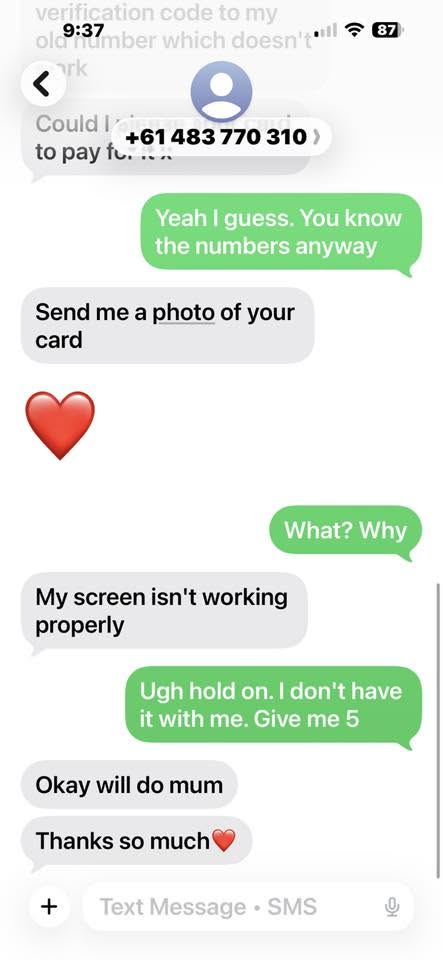
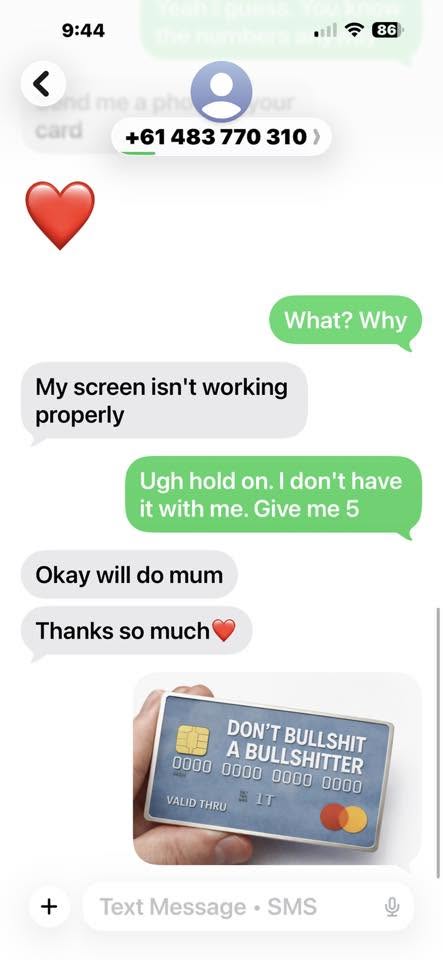
Strangely, I’m still waiting to hear back.